|
|
Already a premium subscriber?
|
|
|
|
Flash game not working or 'No Longer Supported'? Fear not! You can still enjoy flash games by downloading the Flash Player Chrome Extension. Simply add it to Chrome, enable it, and all Flash games will work for you!
 The best Pokemon packs we have ever bought! "My kids only want Ovur packs now" Use code freewebarcade now to get FREE SHIPPING! Available Now Online poker tables load in a browser tab and update for all seats at once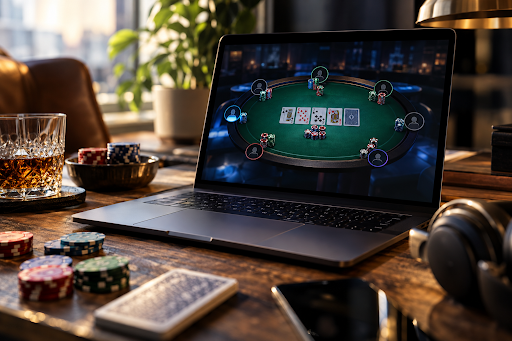
A poker table in a browser is a distributed system disguised as a simple interface. One player folds, another raises, the pot changes and the next seat becomes active. Those changes may look instantaneous, but several machines, network connections and rendering processes are involved before every player sees the correct result. The difficult part is not drawing cards or moving chips. It ensures that every client agrees on the public state of the hand while private information remains confined to the player entitled to see it. The browser loads a client, not the game itselfA browser table usually begins with an HTTPS request. The page delivers JavaScript, graphics, interface components and configuration data, after which the client opens a persistent connection to the game server. The table can then receive new state without reloading the document. This delivery model is what allows online Poker to run inside a browser while behaving more like a live application than a conventional website. User input travels upstream; accepted game events travel back. WebSocket is a common transport because it keeps a bidirectional connection open rather than requiring a fresh HTTP request for each update. That solves the communications problem. It does not decide whether a raise is legal, whether a player may act, or which information another seat may see. Those decisions remain on the server. A click is only a request until the server accepts itConsider a raise. The browser may know what the player intends to do, but it cannot declare the new table state on its own. The request reaches the server with enough context to associate it with a session, table, hand and acting seat. The backend checks turn authority, stack size, wager amount and timing before accepting it. Only then are the pot, stacks and next action recalculated. That distinction matters when a client is stale, modified or temporarily disconnected. A browser can submit an instruction, but the authoritative version of the hand lives elsewhere. Once accepted, the event can affect several visual elements at once. A single raise may reduce one stack, increase a bet, change the pot, alter the legal actions available to the next player and move the turn indicator. Each client renders those consequences from the state supplied by the server. Every player shares the hand, not the payloadSynchronization is often described as sending the same update to everyone. In poker, that would be a serious design error. Some data is genuinely shared: seat occupancy, visible chip stacks, current bets, pot size, board cards, exposed actions and the active seat. Other information is deliberately asymmetric. Unrevealed hole cards belong to one player. Legal-action prompts apply to the seat whose turn it is. Authentication and session data may be unique to a connection. The boundary has to be enforced before transmission. Hiding an opponent's cards in the interface is not enough if those cards were already delivered to the browser. A user controls the local machine and can inspect network traffic, memory or modified client code. The safer rule is straightforward: data that a player is not authorized to know should never enter that player's client. "At once" is a question of order, not identical timingTwo players can see the same action appear almost together without their screens changing in the same millisecond. Each seat has its own route to the server, round-trip latency, processor load, browser event loop and display refresh cycle. A message may arrive first on one machine and be painted first on another. What the system needs is not a shared rendering clock. It needs a shared event order. Sequence numbers or state versions allow a client to determine whether an event is current, stale, duplicated or missing. That is more useful than trusting wall-clock timestamps alone. If seat four raises before seat six calls, every client must eventually agree on that order even if their animations finish a few milliseconds apart. Broken connections reveal whether the design is soundNormal play says little about the quality of a synchronization system. The harder cases begin when a player briefly loses connectivity, returns from a suspended tab or retries an action after receiving no acknowledgement. A production system needs identifiers for hands and actions, ordered event metadata and some means of recovering state. Duplicate protection prevents a retried wager from being applied twice. Sequence gaps reveal that an update was missed. A reconnecting client can receive replayed events or replace its local view with an authoritative snapshot of the current table. Background tabs introduce a different failure mode. Browsers may throttle animation and timers when a page is hidden. A countdown shown on screen therefore cannot be the final authority on whether time has expired. The relevant deadline has to come from the server, with the browser recalculating what remains when it becomes active again. What looks like one table updating everywhere is the product of stricter machinery: server-controlled state, ordered events, recipient-specific data and explicit recovery when a client falls behind. The interface is the easy part. Keeping every seat in agreement without revealing the wrong information is the actual engineering problem. Online poker involves financial risk. Adults who choose to play should set firm spending and time limits, avoid using money required for essential expenses and seek appropriate support if gambling becomes difficult to control. |